
January 1, 2026, marks the beginning of the next quarter-century.
The 21st century was meant to be a Project for a New American Century. The architects of the masterplan were ushered into office fatefully in January 2001. A cabal of neoconservatives led by Vice President Dick Cheney buttressed President George W. Bush.
They needed a moment.
Then came the attacks on the morning of September 11, 2001. Nothing could have shaken the modern calm more than the twin towers of American capitalism disintegrating, with the world watching.
What followed, nearly every year since, has been a mania of moments.
The invasion of Iraq was vociferously opposed in the streets of global capitals. Then it happened. And the world kept turning.
A tsunami hit the shores of Asia, taking a quarter of a million lives in one event. Then it faded into history.
The Global Financial Crisis arrived with shock and awe in 2008. And then went away as fast as it came, with markets climbing to all-time highs.
The first Black president changed America. But didn’t.
A green revolution in Iran erupted. Then subsided.
The Arab Spring ushered in a wave of revolutions and uprisings across the Middle East, Central Asia, and Europe. Soon, new potentates arrived to take the place of departed ones.
The capture of Crimea crossed a red line never to be crossed again. And then it was. Again, and again.
A billionaire showman seized the presidency with bombast. Then he went away, was tried, and was almost assassinated. And then he came back to the presidency, and…
At that same time, conspiratorial rumors around pizza, pedophiles, and a global elite became the crazy of the day. Soon, a version of the crazy of the day came true, in a sense, with the man pulling the strings arrested. But he died in his jail cell, alone. Next.
A once-in-a-century pandemic happened. The world stopped, as did everyone’s day-to-day lives. And then things resumed.
Along the way, new technologies and companies have changed our lives forever. Google. Amazon. YouTube. Facebook. iPhone. Uber. Bitcoin. OpenAI. Ozempic. Download the next update!
Modernity is best typified as an addiction to mania and moments. Our world functions like a scroll, with each moment a reel that must wholly capture our senses, heighten our reactions, and elicit our interest before we move on to the next. With each swipe, we need more from each moment. Everything is intertwined, and thus everything becomes the same. The sameness evolves into a sense of nothingness. We cannot feel. We cannot relate. We are detached from ourselves and from each other. An injection of residual moments brings temporary dopamine on the surface - bits of memory – but it dissipates fast.
We have reoriented reality through this lens. The dulling of our senses enables us to absorb more change, but the more change we absorb, the duller our senses become. This is why we are accelerating without brakes towards all-consuming transformation. While we may be numb to the idea of change, the consequences will be real.
The tidal waves on the horizon this quarter-century will consume many unwittingly, unless they learn to surf above, understanding what flows beneath.
The Moment is the Message
Famed Canadian philosopher Marshall McLuhan coined the phrase “The Medium is the Message” in 1964, in response to the television age. We are at the century mark of mass communication, which began as the radio age, moved to television, then the internet, and now has splintered into social channels imbued with artificial intelligence. The notion of the medium has evolved beyond its original meaning and the frame of mass media.
Today, we have an ever-constant flow of interactive moments. What is viral is ubiquitous, and what is ubiquitous is viral. In that loop of constant consumption, the urgency of now is tagged to each post, highlight, and story. Disruption is no longer phenomenal but mundane.
This extends beyond the superficial to permeate all aspects of society. When Apple became the first trillion-dollar company in 2018, it was an unprecedented event. NVIDIA went from a $1 trillion market capitalization in 2023 to $5 trillion in just two years. Now, individuals are on the cusp of becoming trillionaires.
What appears suddenly can disappear just as fast. The velocity of the moment is blinding. While at first, the pace of change was blinding – and perhaps unsettling – it is now normalized, and we are desensitized. We expect the extreme. The audacious. The unprecedented. If it is not extreme enough and doesn’t push the frontiers of what we have already seen, it is that much less impressive. It becomes easy to cast aside.
This pushes all things to become about everything. The geopolitical is spiritual. The spiritual is financial. The financial is philosophical. The philosophical is technological. The technological is geopolitical. The lines do not matter as much. Is it a stock market or gambling? Is it a media outlet or a nuclear company? Is this person a podcast host or a political adviser? Is he a billionaire or an influencer? Everything, and everyone, has become everything, and that, of course, makes everything a little bit of nothing that flows into a vast tundra of sameness.
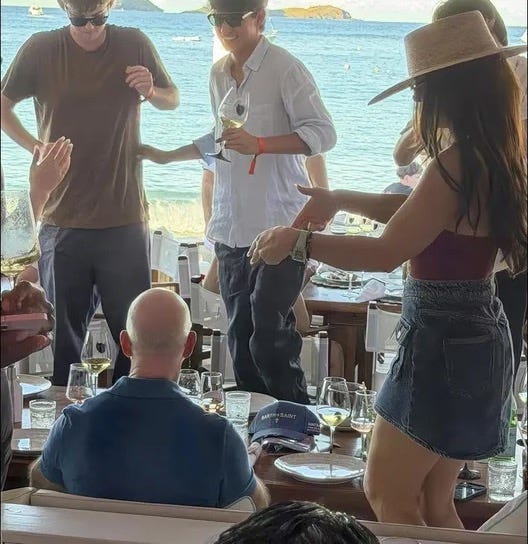
This winter, the world’s wealthiest group gathered around St. Barth’s and its environs. With hundreds of yachts in tow, and inhabitants ranging from Sergey Brin to Miriam Adelson, it was punctuated by a scene of Amazon founder Jeff Bezos and his wife having a frolicking time. What becomes important is not the wealth, nor the cast of characters, nor even the event itself, but the photo, the image, the virality, the short-lived moment that lives briefly in the scroll.
As moments do indeed fade, there must be successive moments. The nature of the collective attention span, however, means that what is new quickly displaces what is slightly less new. What is new must also be new in its level of ‘shock’. It is why in 2025, the ‘Epstein Files,’ which initially landed with ferocity, did not have much resonance.
If tomorrow it were announced that a nefarious intelligence agency had indeed killed Jeffrey Epstein, would it matter? If it mattered, would it go viral? If it went viral, how long would it be viral before the next moment? And once it faded from view, would it be recalled? Would there be any resonance? And if there was any resonance, would it lead to any lasting change?
Acrobatics of Axioms and Acronyms
As a global community, we are increasingly interconnected through these moments that, in effect, are primarily filtered through the lens of the greatest power of the age, the American empire. Moments are tagged in terms of the language of empire or resistance to empire, and the political tribal winds surrounding them.
While moments are fleeting, the tags can live on and soon become axiomatic. Yet, as soon as they become axiomatic, the underlying reasons for the axiom remain unexamined. The moments disappear, but the nature of the tags remains and underpins the tribal reality. The tribe is more closely related to moments than to the depth of being. In many ways, the tribe aligns with an online fantasy rather than the offline reality.
An individual living in Malaysia, completely disconnected from Minnesota, can become heavily invested in the cause of racial animus in the heart of America. The last decade, in particular, gave rise to new acronyms and axioms that shaped identity. Black Lives Matter. Build Back Better. Make America Great Again. Online, you are likely to be confronted by duelling icons of yellow ribbons and watermelons in response to the events of October 7 and the assault on Gaza. The iconography itself is the rendering of the moment into identity.
A watermelon on a dating profile becomes existential, as the icon is itself an axiom. Successive moments are then filtered through the perceived identity represented by this icon. Life is experienced through this filter of where a moment or an individual should fit, first consciously and then subconsciously.
Searching for the Next High
What is happening within each individual is still understudied. Many people not only need moments, but they also need moments to be more momentous than any moment ever before. We become manic about the current moment and the search for the next one. A moment cannot just be a moment; it must be everything. It must be the beginning and end of all things. Everything is not just a moment. It is also the onset of utopia. And of the apocalypse. And those that usher in these moments are gods – and devils.
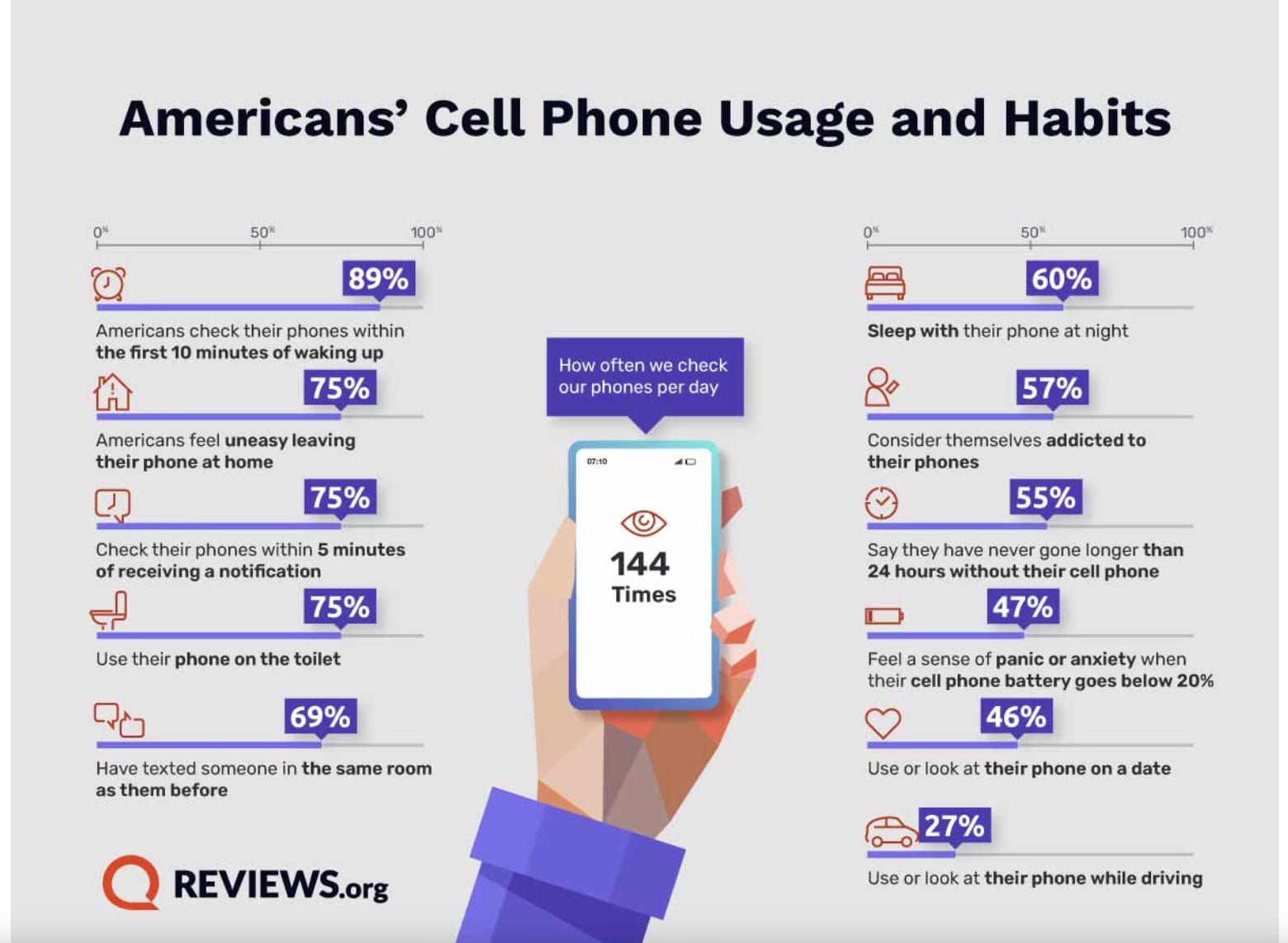
There is a heightened sense of what will satisfy us. But it is not just a ‘trend’. It has become physiological. The ‘hit’ of a new moment provides the fix to restore our level of balance. Once the dopamine wears off and the cortisol takes its turn, all that is left is an exhausted individual and, collectively, a society fatigued, undernourished, and unable to heal.
This is happening in the day-to-day social lives of all, and especially in digital interactions. While global demographics decline, sexuality is on the rise between humans and artificial intelligence. The addiction cycle of moments is playing out with young men and women in a way that will have catastrophic repercussions if unaddressed.
The dulling of sexuality is also part of a dulling of the senses overall, albeit from a distance. The idea of the extreme is desensitized, but not the actual exposure to it. Violence, war, and true upheaval are not experienced by the vast majority of those online and in the West. While people become numb to digital manifestations, they are, conversely, less prepared to face the physical world in all aspects.
This leads to heightened antipathy and empathy. At a societal level, it also means pushing for an over-indulgent response, because, without such responses, identity begins to fade. This is why conspiracy theorists often start with a kernel of truth, but then seek out something more audacious, more outlandish, more skeptical at each turn. When Charlie Kirk was assassinated, it drew in the top conspiracy theorists. If there is not a greater conspiracy afoot, no new moment, can a political group still cling to an identity of persecution? If they are not persecuted, who are they?
If a moment does not occur naturally, it will be manifested and served through the next set of reels into the feeds of today’s identitarians.
Roaring 20s – Part Deux
In this mania of moments, the lowliest of men and women reach the loftiest of heights, and those on the highest perches fall to the lowest ledges. Once you rise, you are exponentialized. As you ride the zeitgeist, with all the connectivity, the resources, the cultural synchronicity, it is an integrated super-ride to the top. You are at once powerful, rich, beautiful, famous, and saintly.

If the launch of ChatGPT was a moment, it was soon ubiquitous. Within two years, the entire world of capital re-oriented, new industries rose overnight in the trillions of dollars to build moment-supporting infrastructure. Capital flows in capital moments, from Series A to Series L. Technology companies all update in an iteration of moments. V1, V2, V3, V4, V5.3. Deal flow aggregates in moments. Milken. FII. Davos. Allen & Co.
The next quarter-century is about the convergence of the hyper-moment and hyper-technology. The speed of change is only matched by the speed at which we perceive it, while disregarding the underlying depth of its consequences. The roaring 1920s did lead to economic growth and stock market booms. New technologies emerged around that time in communications, entertainment, transportation, and atomic energy.
What is different between the 1920s and the 2020s is that the moments are now embedded in the capital and industrial cycles through hyperfinancialization and ‘hyper-technology’, and real-world changes are also occurring. Yet the changes may not be driven by the needs of the time but by the whims of moments. Even politicians are decision-makers in election cycles of moments.
One century ago, the rip-roaring years also laid the foundation for the Great Depression, fascism, communism, and World War II – the great evils that humanity faced and dealt with for the rest of the 20th century. What is the foundation being laid today? What ills and evils could rise at an even more accelerated pace?
Of course, as moments become the frame, some take advantage of the underlying inertia and propulsion to advance in plain sight. They amass the true power, wealth, and influence. And like all potentates, they push a vision that they believe in.
The Eternal Superpower of the Soundless Mind
The mania of moments will not let up. Everything tells us that more will surround us, even as people may become fewer and prosperity concentrates at the top. This may only embolden the moments. Without the ability to take care of themselves, the drip-feed of moments will be the succor that keeps the rebellion of the many at bay.
A disconnect, meanwhile, grows between what moors us and what unmoors us. Values. Connection. Community. Spirituality. Mission. It all just starts to disappear. They all become the moment. Our minds become manic in the moment. We become manic for the moment. And we become manic without the moment.
Each of us today has near-infinite power in our hands. To speak. To build. To trade. To travel. To learn. To connect. To push frontiers. To ride the tidal wave of what is already underway and what is yet to come will require steadiness to allow us to see what is truly happening, and most of all, what is exceptional, versus what has the look and feel of exception.
This will force us not just to see the waves on the surface, but also what has true depth. Technologically. Geopolitically. Economically. And most of all, morally and spiritually. This is the great challenge, here and now. This is the antidote to the mania.
With this disposition, however, you may be the one diagnosed with mania in our moment.
Next.