
The world is still waking up to the new reality of the old nature of geopolitics: hard power.
While many countries have entered the race to build hard power, others prefer the mirage of a rules-based order. The power-based order, however, is already reshaping international relations inescapably. After decades of living under an American security umbrella, the Iran War is jolting remaining sovereign rulers out of their slumber.
Being awake to this reality does not translate to navigating it successfully. Few countries will ever rise to become major powers; in fact, most lack the industrial base (or time) to develop substantive hard power. Leaders of such states must develop the right alliances to succeed in this new world order.
The starting point is to be clear-eyed about what hard power is and isn’t, and how to build it or survive in its midst.
Soft, Smart, Hard
In the 1990s and 2000s, terms like soft power and smart power were en vogue. They were relevant to success within the umbrella of a hard power structure, particularly for America. They were also often related to mollifying sub-state groups and polities. Many countries emulated the American model of soft and smart power, building aid apparatuses, diplomacy networks, and media outfits. While these can still be useful, they will be far less important than building strategic alliances and intertwined industrial bases.
In fact, if you are a ‘soft power’ in the world today (and definitely tomorrow), you are broadly irrelevant. That does not mean you cannot have prosperity – you can. And it does not mean that you cannot leverage your prosperity to influence others – you can. But it does mean when the stakes are real, you do not have a real seat at the table. And when the stakes are existential for you, you will need to be enmeshed with the hard power of others for protection.
The case of Ukraine masks this reality for Europe. Ultimately, American power is still backstopping Ukraine and enabling it to partly protect itself against Russia. If America were to withdraw this support, Ukraine would be unable to wield sovereign hard power. Fundamentally, rulers need to drop wishful thinking about their underlying condition. It is what it is. Accepting that will help develop a clear-eyed strategy about what to do next.
Hard Power World
While hard power has come to be synonymous with nuclear weapons, at the end of the Cold War, two nuclear states, South Africa and Ukraine, voluntarily disarmed. For power to be real, it must be intrinsic and integrated. Hard power is about a weapons arsenal but also about the command-and-control surrounding it and the broader structure of rule. The structure must be able to operate in a sovereign manner.
A hard power country can exist without being a major power. There are three major powers in our world today: China, Russia and the United States. Israel, North Korea, Turkey and, ostensibly now, Iran can be viewed as hard powers. A country’s hard power, however, is not real until another hard power tests it. Venezuela (and perhaps soon Cuba), while posing as an adversary of America, had no staying power in practice.
The nature of hard power in the coming years will be tested most among America’s existing allies, who have yet to face a threat without the backing of the world’s leading power. France and the United Kingdom are nuclear states, but they will need to prove they are not paper powers.
India and Pakistan, in close proximity to each other and to China, have been tested more. Yet their systems are still fragile. In Pakistan, the monopoly of force is not consolidated. India has a history of fragmentation due to subnational governance, civil unrest, and insurgencies, although this has dissipated in recent years.
In America’s circle of adversaries, some military-led systems, such as Myanmar, have pursued partial isolationism, which can create the appearance of hard power. In such cases, it can be easier to overestimate the underlying capability.
The Amazing Race
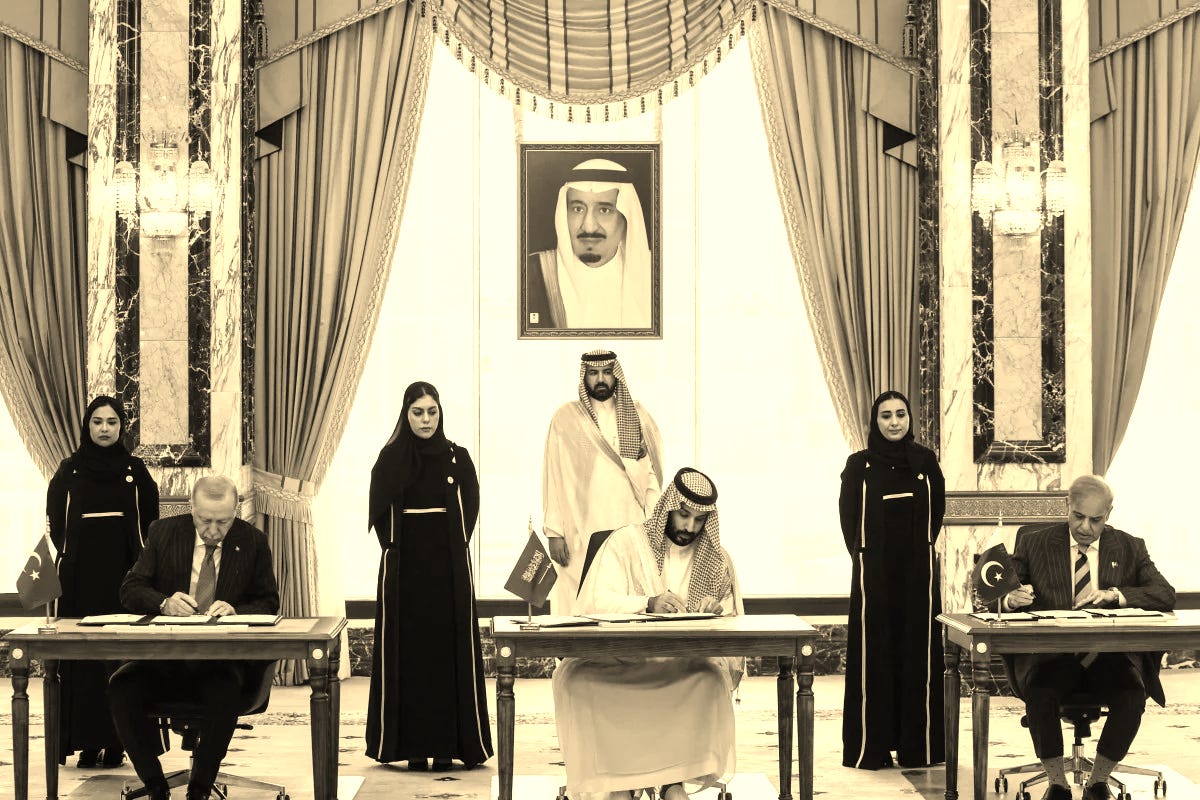
The race to establish hard power is reshaping geopolitics and geoeconomics. Even if rulers decide to develop a sovereign weapons arsenal and industrial base, and consolidate command and control around it, it will still take significant time, investment, and capability. This is beyond the reach of most countries, including those with the monetary means, such as the Gulf states. The Iran War and other geopolitical shocks have made apparent that it makes more sense for them to develop strong alliances. The announcement of a neo-NATO (à la Muslim) that brings together Saudi Arabia, Turkey and Pakistan is a fledgling attempt at just that.
Some see such developments as a sign of American decline, but that need not be the case. America is still a dominant power. Most countries in the relapsing American order will continue to defer to American power and seek to ally with it. Nevertheless, the remnants of this American order will not be reliable in disputes. Chapter VII of the United Nations is effectively dead (and perhaps never was truly alive). This means that countries need to fend for themselves.
Countries that seek to build a hard-power base need to understand what it will take. It means a singular focus of time, attention, and resources. It will come at the expense of health, education, and social services, sometimes to an extreme degree. There will need to be state control of key industries. It will result in international condemnation at times.
In democracies, civilian opposition may make such a trajectory impossible. Either an improbable democratic consensus or, conversely, authoritarian controls would be required to maintain the 10-15-year trajectory for building the industrial base. While autocracies may find it easier to cement this long-term trajectory, they will, in most cases, need to remain within the orbit of American power or risk being excluded from the prosperity required to finance the development of hard power.
The most likely scenario moving forward is that countries that already possess hard power or are on the path to it will have an outsized advantage. We already know, then, who will broadly speaking dominate tomorrow. A few others, perhaps Germany, Japan, Poland, and Indonesia, may be able to pursue breakout capabilities. Nuclear programs are a salient aspect, but as we see in the Iran War, other weapons technologies are also worth developing.
For the rest, we will quickly understand where things stand. Countries like Canada that seek hard power capable of withstanding China, Russia, and the United States will find it challenging. Instead, a relative trade-off in certain domains of sovereignty within an alliance with a major power is what will safeguard overall sovereignty.
This is the realistic path for most countries. Firstly, understanding positioning vis-à-vis the major powers (those in proximity). Secondly, diagnosing the threat matrix from nearby hard powers. Thirdly, developing a modicum of hard power. Then the important next step is to determine an alliance structure with hard powers beyond the major powers and, if required, to co-develop a joint industrial base.
Gradually, Suddenly
The world is moving both suddenly and gradually. Hard power does not develop overnight, and proves itself only when tested. In that vein, countries may still deny the reality all around them until it is too late.
Make no mistake about it. We are already in a world of hard power. But until now, it has manifested itself only sparingly. From here on out, that will change.
We are about to discover just how the world really works.