
Late Friday night, American special operations forces backed by the full might of all branches of the US military carried out a daring and brazen raid in the heart of Venezuela’s capital, Caracas. The raid led to limited military and civilian casualties and yielded the capture of the country’s longtime president, Nicolas Maduro, who landed Saturday afternoon in New York.
The weekend’s events had the hallmarks of the 2003 invasion of Iraq. Yet the operation more closely echoes the arrest of then-Panamanian president Manuel Noriega on January 3, 1990.
The anti-U.S. posture of some governments that has persisted in the Americas following the Cold War may no longer be viable. As the United States under President Donald Trump seeks to cement American dominance, it will do so first, closer to home, in the Western Hemisphere. Deferring to American power is the only surefire way to allay military action.
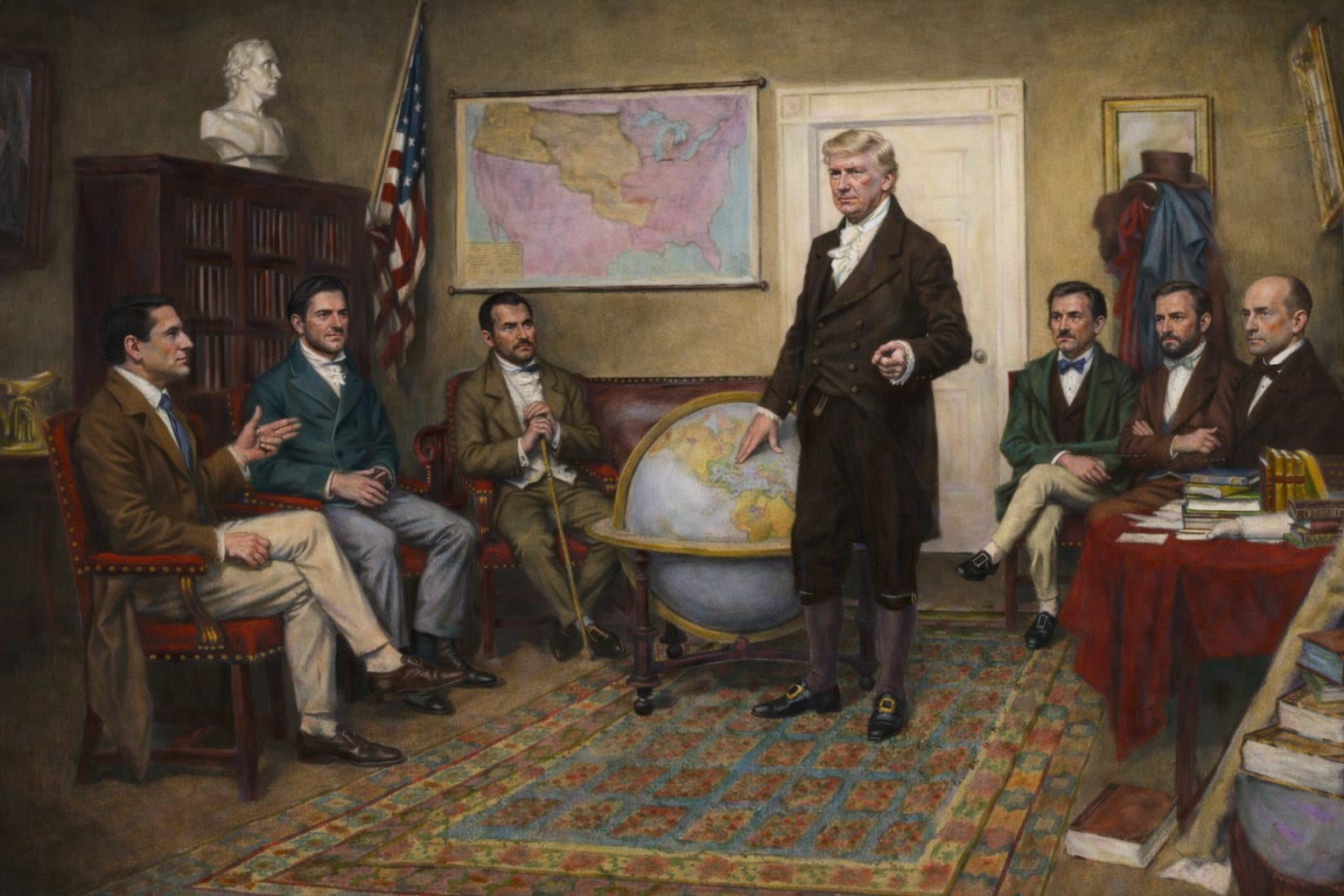
There is one alternative. True sovereignty – but that is not given. It must be established.
The Trump Doctrine
It is too early to confirm a coherent, all-encompassing Trump Doctrine in foreign policy. In Trump 2.5: A Primer, there are three ‘imperatives’ put forward at the center of an emerging one:
Advancing American prosperity
Peace through strength
Balance of power
At the core of the three, and the guiding north star of what is developing as the Trump Doctrine, is not just peace through strength, but peace through the demonstration of strength. Without that last element, American adversaries are unlikely to defer to or even recognize American strength. Following the Iranian strikes last summer and now the operation against Venezuela, those who oppose American interests are taking notice.
In geopolitical physics, every action has an equal and opposite reaction, and that is the risk of the Trump Doctrine, in particular when it is recklessly applied. The modern Middle East clearly showcases the challenges of interventionism. The other worrying implication on the horizon is renewed nuclear proliferation in response.
The Monroe Doctrine, from the early 1800s, has guided American policy in the Americas and was built upon by successive American presidents, including Democratic President Franklin D. Roosevelt. It emphasizes non-interference of foreign powers in the Western hemisphere. During the Cold War, the Soviet Union tested this, notably during the Cuban Missile Crisis.
Over the past quarter-century, America has focused its attention on global pursuits. The Trump Doctrine has emphasized global dominance over empire. The objective appears to be to project global power without restraint or constraint. The expansion of the Monroe Doctrine within the Trump Doctrine, however, goes beyond hegemony in the Western hemisphere.
“It seeks to ensure American military supremacy at all times, in all theatres, and for any eventuality. In addition, it is exercised…on an ongoing basis. Thus, it must be understood that Trump is not an anti-war president necessarily. If there is a threat against America and an enemy does not back down, Trump will exercise military force. However, the theory is that the threat of force, over time, will be enough to compel American adversaries to sue for peace and make deals.” – p. 59 | Trump 2.5: A Primer
Western hegemony, in this view, remains the prerequisite for global power projection. Thus, while Russia and China are outside the orbit of American power, everything beyond their immediate neighborhoods is subject to the Trump doctrine. This doctrine, however, is itself part of a New American Era. Successive presidents are likely to be bound by the era that the actions of this administration have already unleashed.
First Stage – Venezuela
The overnight raids in Venezuela appear to have been a tactical and strategic success. The principal target has been captured. Yet, as any geopolitical advisor or military planner would know, this is only the beginning. The most immediate concern is remnants of the old regime, and full efforts are being undertaken to ensure compliance. This involves potentially future operations, which could both take time and lead to rounds of violence.
To forgo a full occupation, the United States is seeking to ensure a friendly government, and ideally a leader, that can establish a renewed monopoly of force in the territory to prevent anarchy. This is easier said than done. While the incumbent Nobel Peace Prize winner, Maria Corina Machado, has been touted in some corners, others have favored the opposition candidate from the 2024 elections, Edmundo González or a transition, at least initially, from within Maduro’s circle.
The immediate future for Venezuela could be as an American protectorate, with the trappings of independence. It is a test case for forced, induced, or negotiated regime changes in the rest of the hemisphere that could become a normalized expectation when American interests are threatened. Nevertheless, any elongated stretch of uncertainty in Venezuela brings new risks.
Second Stage – Cuba
There is already significant pressure being levied on Cuba. Secretary of State Marco Rubio emphasized this in a recent press conference. The country remains a threat to American interests in the eyes of the U.S. government. It is also a longtime lynchpin of global power intrigue in the Western hemisphere.
A military operation in Cuba would come as little surprise in the coming year. The only way it could be staved off is through comprehensive capitulation by the current government in the country, including a complete transition of power.
Is it possible for the country’s communist apparatus to outlive the current White House? It seems improbable.
Third Stage – Colombia, Brazil, Mexico, and Beyond
Cuba and Venezuela have been the outliers in the Americas for some time. Other countries, such as Bolivia and Nicaragua, often took stances allied with Havana. Anti-Americanism was more broadly prevalent in left- and socialist-leaning governments, such as Argentina’s in the 2000s.
There will be more robust U.S. opposition to this moving forward. Complete deference to American interests in the Western hemisphere is quickly becoming a requirement, as is keeping Chinese and Russian engagement to a minimum. The Trump Doctrine will inform relations with Brazil, Mexico, and Colombia in the coming months.
It is reasonable to ask, what are American interests? Democracy is not voiced as a primary concern. The recently released National Security Strategy reflects underlying forces best understood through broad frames rather than specific policies. All countries in the hemisphere would need to ensure:
Access to natural resources and transportation routes;
Alignment on policies related to the trafficking of goods and migrants; and
Support for American foreign policy objectives.
While this is the White House’s expectation, achieving it will prove more challenging outside Venezuela. Many Latin American countries have entrenched militaries and legitimate governments. Instead, the approach will likely be intermittent pressure and negotiation. Elections are inflection points to be exploited, the most recent example being Honduras.
As a potential staging ground for global power interests against America in the Western Hemisphere, Greenland does not stand apart from this and will increasingly be in the spotlight.
The Global Stage
Venezuela was already weakened and had limited allies. Within the Western orbit, the regime was ostracized and sanctioned. While there may be mutterings of international law, there is already broad acquiescence to Maduro’s capture.
Yet, the precedent it sets will jolt states into recognizing that they are still within America’s dominion, and, if they desire to be outside it, sovereignty will need to be taken seriously as an active process. In 2026, investment in domestic military industries will catapult even further.
More formal adversaries like Iran and North Korea understand that the stakes have risen. Escalatory postures are likely before any détente. Yet, unlike Trump’s first term, when engagement was preferred, both the Biden administration and the current White House raised the stakes of any potential deal.
While China and Russia will object to the American actions in Venezuela, the White House’s emerging global balance-of-power approach could also extend to Taiwan and Ukraine. These powers could benefit from greater leeway in their immediate neighborhoods.
What is less clear is what happens to the framework of the global order that America has long engendered, but that the Trump administration has eschewed. Can global dominance and dominion be achieved without an empire? It is an unresolved question.
The New Era in the Americas
The pronouncement of a new doctrine and era is not an endorsement.
It is a recognition of a time when American power is being fully exercised. The doctrine is set to live beyond the current president – the Venezuela precedent could define the next decade and beyond. While exhortations through op-eds will proliferate, they cannot allay the implications at hand.
The sovereignty principle rules the world, and if countries do not assume sovereignty, they will be subsumed by it.