
This is the third article in the TL;DR section. These will be published sporadically, becoming a library over time that underpins the geopolitical and technological currents covered in the feature essays on the Home Page.
Thiel’s book is as much a guide for starting a company as it is an explainer on why monopolies and mafias rose to create a techno-oligarchy.
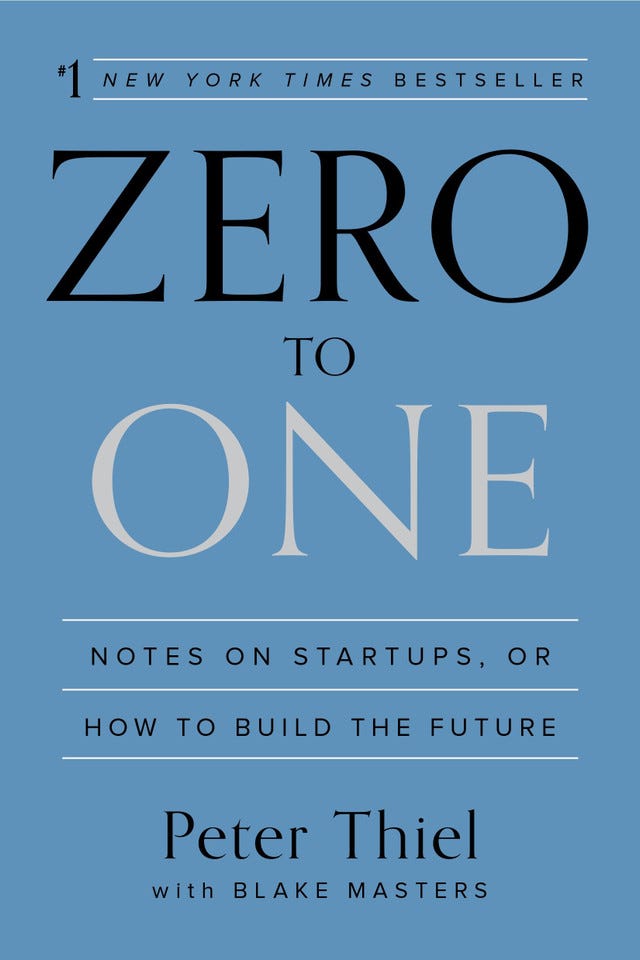
Zero to One: Notes on Startups, or How to Build the Future. By Peter Thiel (2014)
“Monopolies drive progress because the promise of years or even decades of monopoly profits provide a powerful incentive to innovate. Then monopolies can keep innovating because profits enable them to make the long-term plans and to finance the ambitious research projects that firms locked in competition can’t dream of.”
p. 33
The Read
Peter Thiel, who co-founded PayPal and Palantir and became one of the leading venture investors on the planet, writes concisely on his vision of what makes a successful company. The book, which was co-written with one of his many acolytes, in this case, Blake Masters, is a quick read.
Zero to One covers many concepts, but three salient ones are worth highlighting. The first is captured within the title, and relates to bringing new technology into existence – i.e., innovation. Thiel then highlights that what enables a company to win or capture an industry is being a late mover, not necessarily the first entrant.
The third concept is perhaps the most controversial, and that is his praise, if not his belief in the necessity, of monopoly over competition to drive success and ultimately innovation. Whether this is true or not, it is how much of Silicon Valley has operated, as seen with Microsoft, Google, Meta, Apple, Tesla, and so on. There are additional notes throughout the book on founder dynamics, teams, and the future.
Between the Lines
Zero to One is as relevant today as it was when it was first released over a decade ago. Many of the characters remain, partly due to the PayPal mafia’s dominance in the landscape. That group includes divergent figures like Hoffman and Musk, who remain at odds with one another. One could argue that this group is driving today’s politics, in addition to shaping Silicon Valley’s direction.
Yet what is clearest when re-reading this book today is that techno-oligarchy is a feature of the vision, not a bug. Perhaps a sequel needs to be written to understand the implications across the technology industry within the context of the wider American economy, as capital accrues to a narrow band of companies. Today, the ‘Magnificent Seven,’ as they are known, have led to the largest concentration at the top within the S&P 500.
Finally, while Thiel acknowledges that the last four decades saw limited technology gains, mostly in IT, he fails to diagnose whether that is a result of the very nature of monopolistic practices he espouses.
Long or Short?
Go short on Zero to One. This can be covered in an Audiobook or summary, even though the main points are indispensable (but they can be covered in 5 pages or less).